Defining Hyperbaric Oxygen Therapy
Hyperbaric oxygen therapy involves breathing high-concentration oxygen inside a high-pressure environmental chamber. Specifically, the Undersea and Hyperbaric Medical Society (UHMS) states this therapy is clinically valid only when performed at a minimum pressure of 1.4 ATA. Furthermore, all officially approved medical uses require at least 2 ATA. Therefore, this procedure forcibly dissolves more oxygen into a patient’s bloodstream compared to breathing at normal sea-level pressure.
Physiological Mechanisms Inside Patients
Henry’s law in physics dictates that the quantity of gas dissolved in a liquid remains proportional to the surrounding environmental pressure. Consequently, the elevated air pressure inside a hyperbaric chamber forces additional oxygen molecules directly into a patient’s blood plasma. Subsequently, blood circulation distributes this extra oxygen volume through cellular tissues experiencing hypoxia. This supplemental intracellular oxygen supply subsequently supports accelerated biological recovery processes.
This is general information. Consult your doctor before starting HBOT.
Analyzing 2.4 ATA and 2.8 ATA Options
One ATA unit represents normal air pressure exactly at sea level. We operate 2 therapy session options at Carmala, specifically a 90-minute session at 2.4 ATA and a 75-minute session at 2.8 ATA. Higher pressure levels operate as different clinical protocols rather than simply stronger treatments. Notably, research by M. Heyboer and colleagues (Undersea Hyperb Med, 2014) recorded extremely rare oxygen seizure incidents, with the risk rising slightly from 0 at 2.0 ATA to 1 in 197 cases at 2.8 ATA. Our team helps you choose the right pressure during your health screening.
This is general information. Consult your doctor before starting HBOT.
Multiplace Rooms and Monoplace Tubes
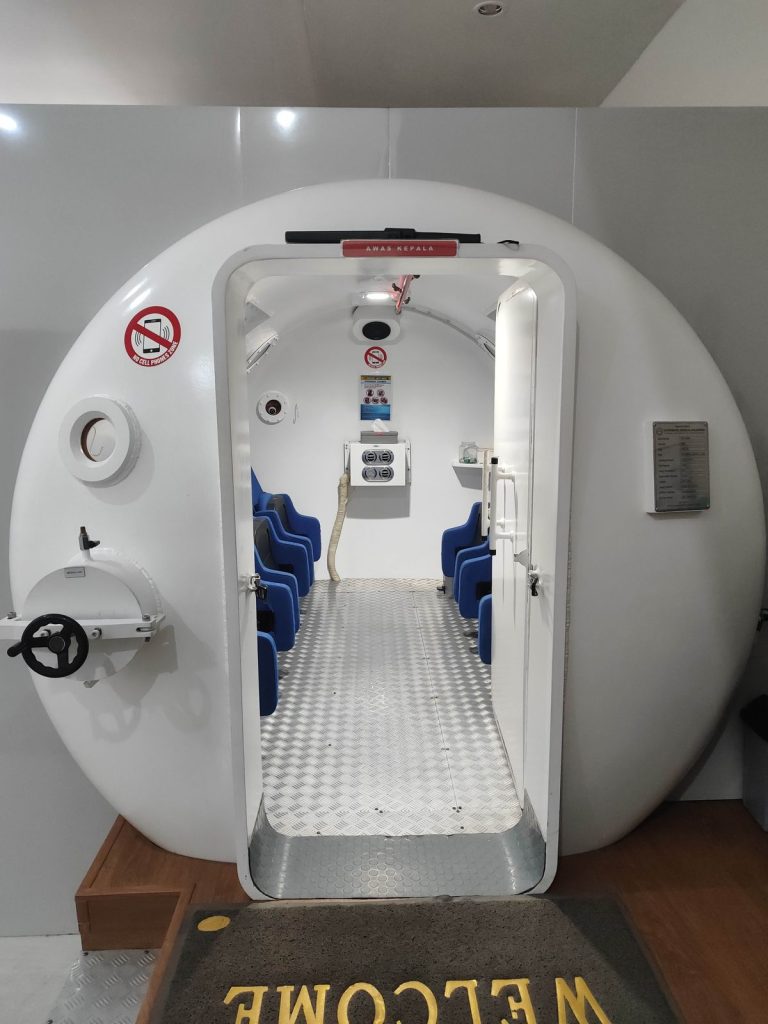
A scientific review authored by Miguel A. Ortega and colleagues (Medicina, 2021) categorizes HBOT equipment into 2 primary structural formats. Monoplace chambers hold 1 patient completely surrounded by pressurized oxygen gas. Conversely, multiplace chambers hold several patients simultaneously who receive oxygen through individual face masks. Carmala utilizes 1 shared clinical-grade multiplace room holding 6 upright armchairs.
Additionally, patients should remain aware of soft fabric chambers that generally operate below 1.4 ATA. Official UHMS statements assert these soft rooms deliver an oxygen volume equivalent to simply breathing through an oxygen mask in a normal home environment. Consequently, sessions in soft chambers fail to qualify medically as hyperbaric therapy sessions.
Standard Session Process in Denpasar
Every operational session at our clinic follows 5 structured procedural stages. First, staff members welcome your arrival and manage the clinical history health screening. Second, we check vital parameters including your resting blood pressure. Third, the operator increases internal air pressure gradually while guiding your ear equalization techniques. Fourth, you breathe high-concentration oxygen in your armchair under visual staff supervision. Finally, we decrease room pressure slowly until reaching the normal 1 ATA threshold before you exit.
Specifically, safety regulations require wearing loose cotton clothing. You must enter without facial makeup or hair oil. Furthermore, all mobile phones must remain outside the chamber to avoid static electricity risks.
Research Covering HBOT Applications
The Undersea and Hyperbaric Medical Society publishes a precise list containing 14 globally recognized operational uses for HBOT in its official publication, HBO Indications (2020), Hyperbaric Oxygen Therapy Indications, 15th Edition. These guidelines predominantly reference recovery for diver decompression sickness and carbon monoxide poisoning patients. Additionally, UHMS clinical references validate its use for difficult problem wounds and sudden sensorineural hearing loss.
This is general information. Consult your doctor before starting HBOT.
Clinical Contraindications for Hyperbaric Therapy
Certain physiological conditions create hazardous risks in high-pressure environments. Patients with untreated collapsed lungs (pneumothorax) are strictly prohibited from entering the therapy room. Furthermore, pregnancy and acute claustrophobia serve as major rejection factors during our safety screening. Individuals currently undergoing chemotherapy protocols with specific drugs fail to meet eligibility requirements for this pressurized procedure. Please verify your physiological profile on our hyperbaric therapy side effects page.
This is general information. Consult your doctor before starting HBOT.
Booking a Session at Carmala
The pricing structure for sessions at the Carmala clinic starts at IDR 225,000 for 1 visit lasting 75 minutes at 2.8 ATA. For operational comparison, a 90-minute session at 2.4 ATA costs IDR 265,000 per scheduled visit. We accept client operations daily from 09:00 to 20:00 at Imam Bonjol Square A41, West Denpasar. You can secure your arrival time directly by using the registration form to book a session on WhatsApp.
Frequently Asked Questions
Clinical analysis conducted by C. Plafki and colleagues (Aviation, Space, and Environmental Medicine, 2000) examined 11,376 multiplace shared chamber sessions. They recorded that more than 17% of 782 patients experienced hearing pressure discomfort during the procedure. Therefore, monitoring staff remain present to assist with real-time ear adjustments during the first 10 minutes of the session.
Regarding medical payment procedures, our operations run as a direct private service provider. Consequently, Carmala cannot integrate with or process financial guarantees from BPJS Kesehatan for any HBOT session services
